


-
Entertainment & Sports -
Insights
Big Returns: How Barry Sohnen Built an Empire Off Broken Radios and Unwanted Air Fryers

By Morgan Kinney
More than five decades ago, at 22 years old, Barry Sohnen walked into a bank branch with $200,000 stacked neatly in a paper bag. Would they be willing to grant him a line of credit for his fledgling business?
“The banker told me he was about to call security,” said Sohnen, who is a City National client today. “I had long hair and was wearing jeans with holes in them. He didn’t know what to make of me.”
This was not long after the young entrepreneur got his start in 1971, when he visited his dad’s wholesale business and got an idea looking at piles of broken radios, tape players, and stereo systems.
A business model emerged to handle the problem at scale: receive a large batch of a single product, refurbish it, repackage it, and resell it. Suppliers would be freed from the burden and expense, and Sohnen could profit from the like-new products.
The resulting business, Sohnen Enterprises, became a pioneer of “reverse logistics,” a soon-to-be booming industry focused on what to do with all the broken or unwanted stuff that customers return.
That paper bag was proof the Sohnen model worked, even if the person holding it still had a lot to learn. His first bank granted a line of credit, and his patient banker connected him with seminars to teach him about balance sheets, P&Ls, and other business fundamentals he needed to grow. “Those are the skills I use every day,” Sohnen said, “and a good example of how we have always looked at bankers primarily as our professional advisers.”
Going After Growth
Five decades later, consumers are buying—and returning—more products than ever.

“The single biggest decision that I have had to make over the years and continue to make to this day is how to expand,” Sohnen said.
Should he buy or lease a building? Is it the right time to invest in more equipment? What new categories of products should the company go after? One day, they might be working on a run of toasters, and then televisions or vacuums. The production process overall has grown more sophisticated, down to the packaging, which, with the shift to online shopping, must be stronger (and therefore more expensive) to survive a bumpy journey in the back of a delivery truck.
Another decision came recently when he decided, after decades with the original bank that accepted his bag of cash, to switch to City National.
“It had to do with the people and the relationship,” Sohnen said. “When the deal was done, the CEO, Howard Hammond, came down to shake hands and welcome us, which speaks culturally to how City National does things. I’ve always said that we don’t bank with banks—we bank with bankers.”
From humble beginnings, Sohnen Enterprises has now generated billions of dollars and refurbished tens of millions of consumer electronics and small appliances. Operations now span five factories and warehouses across Southern California and in Tijuana, Mexico.
Return an air fryer to a major retailer today, and there’s a good chance it will arrive on a Sohnen production line en route to the next consumer.
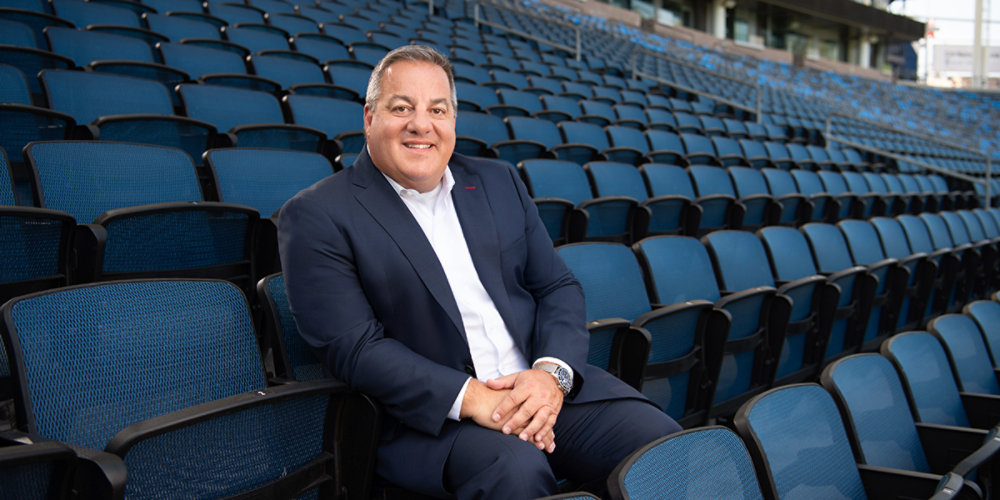
 City National Bank CEO Howard Hammond and Sohnen Enterprises CEO Barry Sohnen
Redefining Success
To this day, the business has no outside investors, allowing Sohnen to define success on his own terms that go beyond the balance sheet.
A few years back, he learned that one of his top workers was functionally illiterate. So, he opened an onsite school to help employees complete their education after hours.
The company started hosting annual health fairs, where any worker can come for free checkups and cancer screenings.
And when it came time for another factory, it was built to achieve LEED Platinum status—a rigorous environmental certification that Sohnen pursued despite it being “almost impossible” to meet.
“We’re community conscious, and that’s at least as important, if not more important, than our financial results,” Sohnen said. “I learned a long time ago that we’re humans before we’re refurbishers or doctors or whatever we happen to do for money.”
“I didn’t think of that 55 years ago,” he added. “Today, my understanding of success is much more mature.”
-
Playing It Smart: How Makai Lemon Is Building Long-Term WealthMakai Lemon, the first-round draft pick of the Philadelphia Eagles, is looking to parlay his NFL earnings into long-term financial security, something that has eluded many professional football players.
-
City National’s Anthony Di Santi Sees No End to Rising Sports Team ValuationsSports franchise valuations are hitting record highs as team owners expand revenue growth beyond selling more tickets and hot dogs.

This article is for general information and education only. It is provided as a courtesy to the clients and friends of City National Bank (City National). City National does not warrant that it is accurate or complete. Opinions expressed and estimates or projections given are those of the authors or persons quoted as of the date of the article with no obligation to update or notify of inaccuracy or change. This article may not be reproduced, distributed or further published by any person without the written consent of City National. Please cite source when quoting.



 Top
Top